Showing posts with label love. Show all posts

Thursday, 30 June 2016

Finger Pointing

The old adage about every time you point a finger at someone there are three pointing back at you tries to prevent a blaming culture and have us all take responsibility.

Sometimes though, we need to point fingers. 

Sometimes we just need to say things, because they need to be said.

Bob Dylan said his song Blowing in the Wind, wasn't a 'protest song' because he didn't write protest songs, he said:


'I'm just writing it as something to be said, for somebody by somebody.'
 (Cited by Peter Dreier  in The Political Bob Dylan,  Dissent, 2011).

Blowing in the wind has its questions and answers which are unspecific to a time, people or place. The answers are 'blowing in the wind'. It is up to us to recognise or find them.

Sometimes though we need to point fingers, as Dylan said:

 'you know pointing to all the things that are wrong.' 
(Cited by Jon Bream in Dylan: Disc by Disc, 2015)
Things like war, inequality and injustice. Whether it is the Vietnam or Iraq war or Civil Rights in the US in the 60s or the racism of Brexit in the UK today.

Rolling Stone has a Ten Best Protest Songs of All Time list. As do most music media sites. My favourites include the following ones (in no particular order) from my childhood and since:
  1. Imagine by John Lennon
  2. Feed the World by Band Aid
  3. In the Ghetto by Mac Davis and sung by Elvis
  4. Give Peace a Chance by Toots and the Maytales
  5. Get Up Stand Up by Bob Marley
  6. Talkin Bout a Revolution Tracy Chapman
  7. Between the Wars by Billy Bragg
  8. Another Brick in the Wall by Pink Floyd
  9. Where is the Love? By Black Eyed Peas
  10. Zombie by The Cranberries
  11. Big Yellow Taxi by Joni Mitchell
  12. This Land is Your Land by Woodie Guthrie
  13. And the Band Played Waltzing Matilda and 14. The Green Fields of France by Eric Bogle
As I write this I happen to be wearing a Tshirt with Bob Marley's Get Up Stand Up emblazoned across it and just now listened again to Bragg's  Between the Wars in tears. We should be upset. We are still battling for a living wage in the UK and still seeking justice and equality in so many ways. We should be singing songs like this.

One of the lines which has always caught me is Manic Street Preachers':
'If you tolerate this your children will be next.'

This reminds me always of the words from Martin Niemöller I spoke of in my post Never Doubt:

First they came for the Socialists, and I did not speak out—
Because I was not a Socialist.

Then they came for the Trade Unionists, and I did not speak out—
Because I was not a Trade Unionist.
Then they came for the Jews, and I did not speak out—
Because I was not a Jew.
Then they came for me—and there was no one left to speak for me.

In a Guardian article Jonathan Luxmorre and Christine Ellis (2016) ask 'where are all the protest songs?' Sadly I wonder if they have all already been written and performed and we are just waiting for people to finally hear them.

Sunday, 14 February 2016

52x52: Forget the Valentine Give a Compliment

52 random acts of kindness that each take under 52 seconds. One action each week, over a year takes less than an hour of your life.
  
It's Valentine's Day today and if you want to avoid the materialistic nature of the card industry why not make your own. Better still drop the whole routine and instead use it as an excuse to tell everyone you know what you love about them. That your neighbour is so kind (takes in your post and doesn't forget to drop it round like previous neighbours). That your friend is so dependable (even at 3am). That your work colleague is so hard working (and never eats the last doughnut). That your mum is such a role model (except for that fashion craze she thankfully has given up). That your loved one is so funny (and you don't just mean that accident with the juicer and the peach stone.).

This week, in 52 seconds you could tell 26 people what you love about them. Just 2 seconds each time. All you have to say is:

"What I love about you is that you are ______"

Thursday, 10 December 2015

Generosity: The Four Kinds of Giving

The Dalai Lama (2012) in his book 'Beyond Religion' talks of 'ethics for a whole world' and speaks of the following 'four kinds of giving' (p.130):
  1. giving material goods
  2. giving freedom from fear – providing safety, security and honesty
  3. giving spiritual counsel – providing 'comfort, concern, and advice to support others' psychological and emotional well-being
  4. giving love
The Dalai Lama has the following to say about generosity:

'It seems worthwhile to say a few words about the value of generosity. Generosity is the most natural outward expression of and inner attitude of compassion and loving-kindness. When one desires to alleviate the suffering of others and to promote their well-being, then generosity – in action, word and thought – is this desire put into practice. It is important to recognise that “generosity” here refers not just to giving in a material sense, but to a generosity of the heart.'
(Dalai Lama, 2012, p.129)

Let's be generous. Like a puppy, generosity is not just for Christmas !

Wednesday, 28 October 2015

Loyalty & Love

'Our Man in Havana' is a comic look at international espionage and the role and unreliability of informants in state affairs and although it shows its age by some of its inappropriate racial references it is also ahead of its time in its predictions.

I left London for Havana, having read Our Man in Havana (1958) by Graham Greene, set in both London and Havana and planning to watch the Alex Guinness black and white version while there. We watched it noticing we had passed Sloppy Joes, one of the locations on the film and while we sat eating sloppy joes at the home of the original sloppy joe, on the TV appeared Our Man in Havana.

Today the messages still hold true, whether they are black and white on the page on on the screen:

'Would the world be in the mess it is if we were loyal to love and not to countries?'

Saturday, 18 July 2015

Gift Legacy

In 4 Ways to Find Purpose in Any Job, Steve Errey, talks about legacy as a 'gift of property, by will' (see Viscott's version here). People like Gandhi and Mother Teresa made their marks and we can make ours, in everyday life:

'[L]ook at your legacy as something you possess that you can gift to others, by your own free will. Time, consideration, skill, empathy, hospitality, experience—all of these things and more are things you can gift to others.'


This is not just for work but can pertain to all areas of life. There is so much we posess which we can gift to others: patience, love, peace, undertanding, joy, laughter...

And the simplest gifts at a time in need can be the best.

Sometimes all we need is a smile.

For more on the power of the smile check out 52x52: Smile

Friday, 22 May 2015

Monday, 18 May 2015

Things That Matter: Equality

'Our lives begin to end the day we become silent about things that matter.'
 (Martin Luther King, cited by Halligan, May 16th 2015, Irish Times)


Irish Tv journalist and political correspondent, Ursula Halligan ended a 54 year silence with the above quote. With the Irish referendum on marriage equality only days away, Halligan revealed her secret self, which had been hidden away in a diary from when she was 17.  She hopes her story will not only help get a YES vote for marriage equality, but save other 17 year olds like her from the pain of repression, injustice and inequality.

Read Article here: Ursula Halligan: Referendum led me to tell truth about myself

Wednesday, 11 February 2015

Love: Manner and Mind

It's easy to say it from the pulpit or counselling session or the hippy filled field at the festival. That we should treat people with love and unconditional positive regard (Rogers, 1956). Its certainly easier to say it than actually doing it all the time, not just when we have enough energy or opportunity or resources and don't feel threatened or under pressure of time or lacking in confidence.

It's an ideal I try to live up to and constantly fail at, but in my trial and error I'm at least marking my place in the book of the person. Sometimes getting through a few lines, othertimes a few pages and eventually whole chapters are read. Those people nearest to me have the best read books. Those futher away are sometimes only acknowleged by a review from someone else or I just get to read the blurb. Many many people, don't even exist in my library. They are in far away libraries, in foreign languages and may never see the light of my day.

The people's books that I do come across, have covers I judge them from. I do sometimes decide I like them on first impressions, by just a few lines. Some books I don't get past the first chapter. 

Most people's books are full of short stories which compile into a series, and a chronological life narrative. I can be part of one or more of their stories and they can be part of mine. But we never see the whole book. And how can you tell if you love a book until you get to the end? You can't - the end might change everything. But with people, you can never know the end. With books, you can however, not necessarily like a particular book or chapter or plot point or line but you can still love reading. I love reading. I love people. That's where I start. At least it gives them a chance.

A man came to the door of our centre, asking for money or food. He didn't want to have to steal, he said. I gave him food. I felt a twinge of concern that he might be manipulating me by mentioning stealing. I was waiting for him to go futher. To ask for money again. He didn't. He then asked if I could help him with another thing. I thought, here goes, what's he going to ask for now? He shuffled his feet and searched the inside pocket of his jacket. What's he looking for, I wondered, is he going to try to con me? He continued to search. It's in here somewhere, he said. He pulled out bits of paper. I have a picture, he said. It's my dog. I have a picture here somewhere. He found it. It was a folded battered picture of a dog. His dog. His missing dog. He was desperately looking for his lost dog. After food, it was his next priority. He was lost without his dog. 

I didn't see this plot twist. I wasn't ready for his story. I hadn't expected this character development. There was a lump in my throat. I was glad that I had behaved in a loving manner even if my mind wasn't quite there, that I had a chance to catch up. To read a little more. And not just judge him by other books I'd read like his.

I took the photo and made 10 x A4 photocopies with space to write a message, to put up around the area he'd lost his dog. He was delighted. Thank you, he said, Bless you. For the food, he said, but especially for the help to find my dog. He was choked, I was choked, for a brief moment in time we were both on the same page.

It's not always easy to think of and treat people with love and unconditional positive regard but its probably how our stories get to have happy endings. 

 
Rogers, C. (1956). Client-Centered Therapy (3 ed.). Boston: Houghton-Mifflin.

Monday, 9 February 2015

Love: Light in Darkness


Martin Luther King said:

"Darkness cannot drive out darkness: 
only light can do that. 
Hate cannot drive out hate: 
only love can do that."


Whether we show our love in a card or a kiss, or buying The Big Issue, we are lighting up the world around us.

At times I have felt like I'm slipping into the darkness, other times it's a constant cloud over my head casting shadows over everything I see. I am paranoid, frustrated, irritated, disappointed, cynical...and what good does that do me? I just make my cloud bigger and more concentrated. It bears down on me, blocking out the light. Clouding my judgement. 


At times, I know the sun exists but can't feel it's warmth or see its light. I think everybody else does and in fact they are stealing from me, what should be my portion of the heat and light. Then I realise I am my own sunscreen, hiding myself from the harm I fear but then missing out on the positive attributes of sunshine and light. In protecting myself I am creating barriers. I am trying to block pain but lose all feeling. The barriers I put up against the hurt I am afraid of also shield me from any feelings of safety, calm, satisfaction, joy and love. 

So I chip away at the walls between me and others, and as the darkness fades and the light replaces it, I can see more. I'm coming out of the prison of my own making. It's brighter. I'm lighter. I'm free.

Looking for the Light

If we think the worst of people and treat them that way it can be no surprise when we get the worst from them.  Part of getting the best from people is thinking the best of them and treating them that way. If we stop concentrating on what we hate about people and instead think of what we love about them it will be a brighter world. Maybe not just for us, but for us all.
  
If, as Martin Luther King said, only love and light can drive out hate and darkness. Then we must seek love and light or we just perpetuate the very hate and darkness we are trying to escape from.

So when our minds become overcast with doubt and the darkness of hatred clouds our judgement, we must look beyond that horizon and look for the light of love.

Thursday, 29 January 2015

Room 101: We Are Our Greatest Fear

Am I Winston Smith or a Prole? I don't know. I don't even know which I'd prefer to be. Would I prefer to live in ignorance or knowledge of the control others have over me? Do I have to know what freedom is to have it? And when we know what it is, is that when we realise we don't have it.
Does that make the slogans in the totalitarian state of Nineteen Eighty-four true? Is it true that Freedom is Slavery? Is it true that Ignorance is Strength? Are we more able to cope the less we know of the evils and hardships of the world? Does knowledge bring fear? 

Fear can hold us back, and make us appear weak. Or the opposite. You bring your guard up. To protect you attack. Is this what is meant by War is Peace? To preserve peace we go to war?

Of course everything is true and not, depending on the context. I could outline a number of examples to prove the case either way. But that would be Doublespeak. For instance, I might not want freedom, to think for myself. I might prefer to submit to the powers that be and live in ignorance, protected from the big bad wolf they remind me of. So I may be a slave to the convention, religion, rule or law enforced but have the freedom that comes with no responsibility. Or as the Goldstein’s Manifesto says 'the consciousness of being at war, and therefore in danger, makes the handing-over of all power to a small caste seem the natural, unavoidable condition of survival'.

So where is our Freedom? What part of our lives is not controlled from outside, whether by convention, religion, law or rule?

Nothing is our own we are told in 'except a few cubic centimetres' inside our heads but we are tested on that regularly whether in SATs tests or in conversation or the way we live our lives in general where if we do not adhere to the norm we are cast out. Its the Garden of Eden all over again. Big Brother and the Thought Police were there as they were in Winston's world, as they are in ours.

And the media and historians write their versions of events, as the party slogan in Nineteen Eighty-four went:

'Who controls the past controls the future: 
who controls the present controls the past.'

Nothing can ever be entirely accurately and objectively recorded. The very act of observation changes it to a subjective act. Eye witness accounts in court rooms are notoriously inconsistent with each other and documentary evidence.

This happens even without conscious intention. Imagine then what can happen when the intention is there. Propaganda like 'weapons of mass destruction'. Propaganda is a weapon of mass destruction. We manage to live in fear avoiding real life world issues such as deprivation and inequality while we protect what we are lucky to have from what appears to be a foreign threat.

We don't want the Proles or Winstons of the world to be educated to the point where we work this out for our selves. We will be harder to control. So our knowledge and education is limited by controlling measures such as charging fees for university (a financial control barrier) or by limiting our vocabulary and range of thought processes with Newspeak.

Don't you see that the whole aim of Newspeak 
is to narrow the range of thought? 
In the end we shall make Thoughtcrime literally impossible, 
because there will be no words in which to express it.

So if we can't express ourselves we cannot revolt. Of course as Winston said we cannot rebel until we become conscious or become conscious until we break the mould with rebellion.

So the world was round and flat at different times. Winston asks is a lunatic just a 'minority of one?' Just a non conformer. Just because everyone else thinks it – it doesn't make it so.

'Being in a minority, 
even a minority of one, did not make you mad. 
There was truth and there was untruth, 
and if you clung to the truth even against the whole world, 
you were not mad.'

What if our selfishness and greed was wiped out in evolutionary terms, in wars and murders. Could we evolve as humans to be able to life in peace, truth, love and plenty (the ironic names of the ministries which were in opposition to the promotion of those ideals). What if our goal in life was 'not to stay alive but to stay human'? Would we get better at it? Could we learn to be better humans rather than live in fear of what is outside ourselves?

Of course, as O Brien tells us, everyone knows what’s in the dreaded Room 101:

'The thing that is in Room 101 is the worst thing in the world.'

Anyone's Room 101 will contain their greatest fear. For Winston it would appear to be rats. However there weren't just rats in the room. There was also O'Brien and Winston. Winston, himself and another human being. Was his greatest fear in fact, the human... and perhaps even himself?

While we fear other humans and focus our energies on them, we don't on ourselves. While security in buildings and airports is ramped up and we buy more guns to protect our homes or we go to war to protect our 'way of life' we fail to see the real dangers. Ourselves. We are more likely to use a gun to kill ourselves than ever have someone else kill us with a gun. The states in the US with the highest rates of gun ownership are also the states with the highest suicide rates (Tavernise, 2013). 'Nearly a third more people die at their own hands than at other people’s' (Radford, 2013) but media still hypes a different view.

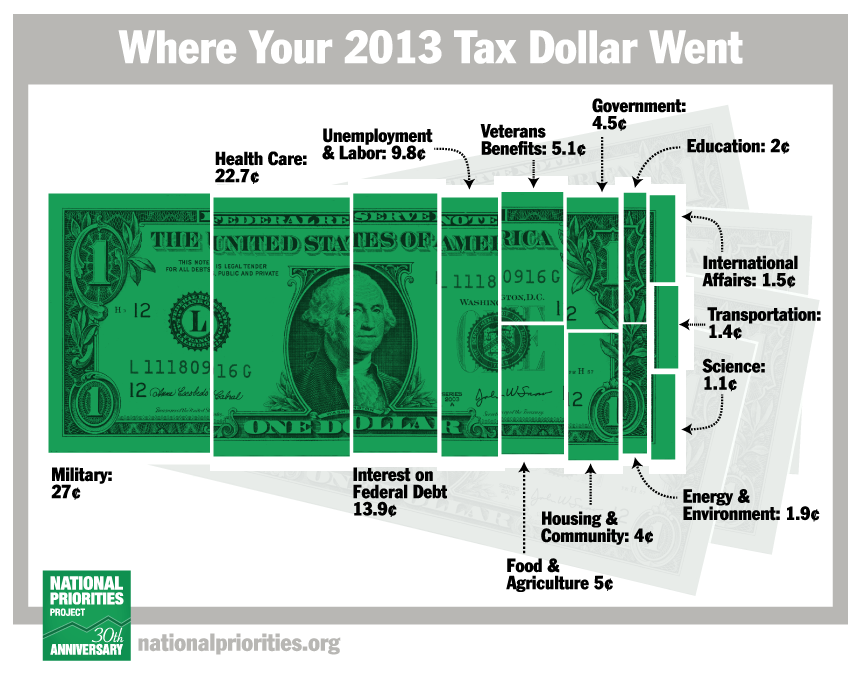
So why are we spending so much on defence and so little on education? In 2013 NationalPriorites.Org showed below how the American Dollar was spent that year :

https://static.nationalpriorities.org/images/charts/2015/taxes-desk.png


So 27% was Military spending while 2% was spent on Education (truth) and 5% on Food and Agriculture and 4% on Housing and Community (plenty). This seems to be out of proportion to need. Health Care (love), one of the biggest spends, still isn't as much as military spending.

Military and Veteran Benefit costs are nearly the same as the costs Health Care, Education, Food and Agriculture and Housing and Community combined. Imagine if the 33% spent on war was instead spent on peace and all its associated truth, love and plenty. The money could be spent on lessening fears whether related to war, or ignorance, or pain or deprivation and help promote the ideals and reality of peace, truth, love and plenty.
It won't happen overnight but we can begin with ourselves and finding the good that is in us all, spread that good and share that good. Look for it in others. Realise that taking a life out of the equation, whether someone else's or our own will not help us to find answers. That we all deserve peace, truth, love and plenty. 

We know the phrase - 'You are your own worst enemy.' Does that mean I am my own Room 101?


References:

McLeod, S. A. (2009). Eyewitness Testimony.
Orwell, G. (1949, 2013) Nineteen Eighty Four, Penguin Classics
Powell, C. (20013) Full Text of Colin Powell's Speech, The Guardian
Tversky, B. & Fisher, G. (1999) The Problem with Eyewitness Testimony 
Tavernise, S. (2013) To Reduce Suicide Rates New Focus Turns to Guns, New York Times, February 13
Radcord, B. (2013) Is Suicide a More Present Danger Than Murder? Psychology, Discovery 

Sunday, 28 December 2014

Recycling Ideas, Learning and The Christmas Spirit

CAYR (Christmas All Year Round)
Recyclng ideas or reinforcement of learning works for the positive when the ideas and learning are positive. When otherwise are otherwise. The learning cycle can have an upward or downward spiral which can evolve like a virus creating immunity. Bacteria can multiply in the psyche and are not always the good kind that keep us healthy and protect us from the bad.

Gladwell's ideas of epidemics mentioned in a previous post are much like Dickens' in A Christmas Carol :

"It is a fair, even-handed, noble adjustment of things, that while there is infection in disease and sorrow, there is nothing in the world so irresistibly contagious as laughter and good-humour."
(Dickens, 1843)

Leading up to Christmas, I was ill and not feeling at my best. So, when one day after another, one man screams blue-murder and another says he hates Christmas and another stares vacantly at me not even able to comprehend its Christmas, I try to put up barriers agains infection and instead try to spread good humour, however hard it feels. 

Its not just the person who doesn't have a certain belief or tradition in their culture,  or a moaner or groaner or the 'Scrooge' saying 'Bah Humbug'. Many blame the loss of 'Christmas Spirit' on the 'business' of Christmas. The so-called commercialisation of Christmas is regarded as one of the great epidemics of our time. So is the answer to the problem simple? Not to get involved in it...be part of the solution and not the problem? As Dickens' Ghost of Christmas Past said of what we should make our business:

"Mankind was my business. The common welfare was my business; charity, mercy, forbearance, and benevolence were all my business. The dealings of my trade were but a drop of water in the comprehensive ocean of my business!"
(Dickens, 1843) 

One of the men, who I had seen become disillusioned over time, complained of people wishing him Happy Christmas when the rest of the year they ignored him. We talked of people having the Christmas spirit all year. Of seeing the caring behaviour of people at Christmas-time being an all year-round norm.

As Scrooge learned from his ghosts so too will I try to learn from mine and say as he did:

"I will honour Christmas in my heart, and try to keep it all the year."
(Dickens, 1843)

So the answer: To recycle Christmas all year long. Not just the tree and cards and empty bottles, but the feelings of love and joy and caring for those around us. 

CAYR 
 
 Christmas All Year Round

or more simply put...

  Caring All Year Round


Thursday, 25 December 2014

A Christmas Poem: The Christmas That I Love


A Christmas Wreath of Helping Hands

The Christmas That I Love
 
White Christmas on the radio
Spotting the first drop of snow
Tangerines and clementines
 Family, friends and good times

Hanging the Christmas stockings
Highstreet and online shopping
Dickens' A Christmas Carol
Christmas jumper apparel

Candles flicker frosted pine
Christmas markets and mulled wine
Animated three Snow Kings
Shepherds tea towels n' angel wings

Brusselssprouts and potato peels
Christmas carols and leftover meals
Christmas tree and fairy lights
Sweets and treats and more delights

Hospital visits and good cheer
Skies so bright, day and nights so clear
A Christmas tree of green hands
Sounds of Salvation Army bands

Sherry trifle Christmas pudding
Wrapping presents, hiding things
Christmas dinner and paper hats
Cracker jokes and cheery chat

End of Year TV Roundups
Hot-chocolate marshmallow cups
Children's Christmas party games
Santas suitcase n'candy canes

Trying to make mum's stuffing
Hearing the New Year bells ring
Sitting in cafes to write
Watching Its a Wonderful Life

None of this can ever matter
Nothing can make me happier
Not a world of Christmas Fayre
Is Christmas without you there

A Christmas Tree of Hands