Showing posts with label truth. Show all posts

Tuesday, 24 March 2015

On Writing: Short Stories


'writers are watchers'

Joseph O'Connor (1997) discusses writers as 'watchers' in his Introduction to the 1997 Fish Anthology, Dog Days & Other Stories. O'Connor talks about such watchers/writers as Raymond Carver and Flannery O'Connor and their observation skills, not in any classic or academic or scientific sense but in an almost childish and ignorant sense, without the barrier of prejudice, a way of seeing that assumes or presupposes little, creating an ability to be open to the revelation of the extraordinary in the ordinary (Ibid).

I used to want to know everything. That was until I knew I couldn't. When I knew I couldn't, I stopped feeling that I was a lesser person or uneducated because I didn't know something in particular. I stopped gathering knowledge like cheap beads for necklaces I would never wear or sell or give as gifts but hoard in boxes for no other reason but to acquire, to be in possession of, to have power over and control. I still wanted to learn and when I stopped feeling guilty and let myself off the hook, I was able to disengage from the fear and pressure and was free to 'watch', to be one of the intrepid explorers I admired as a child. They weren't any better than me. I could be just like them if I let go of such a tight reign on my insecurities and used them instead to help me question, interrogate, examine and wonder. I am just like the 'watchers' because I am one of them. Instead of having made up our minds about everything we see, we wonder and wait to be presented with new information, to see other aspects uncovered, to be enthralled, surprised and uplifted by the light of the hidden brilliance of the everyday revealed...to be enlightened.

As O' Conner (1997) writes we: 

 'watch for the extraordinary magic that lies in the everyday.'

O'Connor tells us we have to have our eyes open all the time, that we are always trying to 'make some sense of things', that we are writers 24/7, that its important to be writing all the time, even when we are not physically tapping the keyboard or putting pen to paper like James Thurber who is admonished by his family at times for that far-away-look that means he is writing in his head (Ibid). We all know that feeling when an idea takes hold. Or when we see something in a completely new light. Or when something becomes a question and an unknown when it was once straightforward and made sense.

O'Connor (1997) considers: 

'A short story is a glance at the miraculous.'

Joyce called them 'epiphanies' and Prichett called them 'something glimpsed from the corner of the eye in passing', according to O'Connor (Ibid). My job as a writer, O' Connor tells me, is then to record this miracle, epiphany or note-worthy something and develop the writing skills to properly present this observation accurately and appropriately. As O'Connor (1997) explains, what we have to do as writers is:

'To tell the truth.'
 

O'Connor, J. (1997) 'Introduction', Dog Days and Other Stories: 14 Winning Short Stories from the FISH Short Story Competition, Ed, Clement Cairns, Fish Publishing
,

Saturday, 7 February 2015

Perspective: Relativity

The Ponzo Effect (Mario Ponzo, 1913)

Is everything relative? Even truth?  

The Ponzo Effect shows two lines of equal length, but one appearing to be longer in relation to its surroundings, which appears to be a railway line disappearing into the distance. Our minds are taught the rules of perspective which interpret lines appearing to be converging in this way as creating the illusion of disappearing into the distance. Therefore we then interpret the line further along in the distance as being longer as it is more distant so must be, according to those rules, longer than the one nearer. 

And that's it. Our minds learn rules with which they interpret the world and our experiences in it. We make definitions and distinctions based on our learning. What exists in our worlds only exist according to those definitions and distinctions. In someone else's world or even possibly in everyone else's world they may not exist as in ours. In which case how can we say what it 'real' or 'true'?

Priest and Garfield (2003) tell us about Nagarjuna's 'two truths': 

"He asserts that there are two truths, 
and that they are one; 
that everything both exists and does not exist; 
that nothing is existent or nonexistent; 
that he rejects all philosophical views including his own;
that he asserts nothing."


Nagarjuna considered there to be two truths - conventional and ultimate, the conventional was relative while ultimate was not relative and ultimately not ultimate.

Conventional truth and reality Nagarjuna broke down into three variations:

1. Ordinary, every day or common sense truth
2. Agreed truth  - like rules and laws or traditions
3. Nominal truth - 'true by virtue of a particular linguistic convention' (Garfield and Priest, 2003)

Paul Rinponche in Clarifying the Two Truths talks about relative truth being two kinds, 'incorrect relative' and 'correct relative'. 'Incorrect relative' is when we only see things as they appear to be whereas when it comes to  'correct relative' we view the world with the knowledge that appearances can be deceptive. 

And what Nagarjuna calls the 'ultimate' truth, Rinponche describes as 'absolute truth'. Both, Nagarjuna and Rinponche, from my reading consider that absolute or ultimate (or what I would call, objective truth) is not available to minds which operate in a relative arena, which most minds built on learning from their environments do.

Riponche cites Shantideva:

 The absolute lies beyond the reach of the intellect, 
 For the mind is only relative, it is taught.

We make distinctions between the various items of stimuli we experience with words and thoughts which change their character. The chair is a chair. It being red or wooden or having a person sitting on it or even being an object that is for sitting on or being part of a dining set are all distinctions I make. I am setting it apart from other things by naming the qualities which I can identify it with, based on what I know.

I am still stuck on working out how to view the chair in absolute terms. Maybe that's the point. I can't. It is, only what it is, in relation to everything else unless you see it all connected together and then it is just part of a bigger whole which so vast and varied it is indescribable. 

Even if I simplify it and reduce it to the wood or metal it is made of,  I see it in relative terms, as a type of material which is hewn from the forest or the ground and manufactured in some way to make chairs, which I only know because this is something I have learned.

So the absolute truth is that there is no absolute truth. Everything is relative.

As Nietzsche said, in the 1880s:

 'There are no facts, only interpretations.' 


Garfield, J.L and Priest, K. (2003) Nagarjuna and the Limits of Thought, Philosophy East & West, Volume 53, Number 1 January 2003, 1 – 21,University of Hawaii Press

Thursday, 29 January 2015

Room 101: We Are Our Greatest Fear

Am I Winston Smith or a Prole? I don't know. I don't even know which I'd prefer to be. Would I prefer to live in ignorance or knowledge of the control others have over me? Do I have to know what freedom is to have it? And when we know what it is, is that when we realise we don't have it.
Does that make the slogans in the totalitarian state of Nineteen Eighty-four true? Is it true that Freedom is Slavery? Is it true that Ignorance is Strength? Are we more able to cope the less we know of the evils and hardships of the world? Does knowledge bring fear? 

Fear can hold us back, and make us appear weak. Or the opposite. You bring your guard up. To protect you attack. Is this what is meant by War is Peace? To preserve peace we go to war?

Of course everything is true and not, depending on the context. I could outline a number of examples to prove the case either way. But that would be Doublespeak. For instance, I might not want freedom, to think for myself. I might prefer to submit to the powers that be and live in ignorance, protected from the big bad wolf they remind me of. So I may be a slave to the convention, religion, rule or law enforced but have the freedom that comes with no responsibility. Or as the Goldstein’s Manifesto says 'the consciousness of being at war, and therefore in danger, makes the handing-over of all power to a small caste seem the natural, unavoidable condition of survival'.

So where is our Freedom? What part of our lives is not controlled from outside, whether by convention, religion, law or rule?

Nothing is our own we are told in 'except a few cubic centimetres' inside our heads but we are tested on that regularly whether in SATs tests or in conversation or the way we live our lives in general where if we do not adhere to the norm we are cast out. Its the Garden of Eden all over again. Big Brother and the Thought Police were there as they were in Winston's world, as they are in ours.

And the media and historians write their versions of events, as the party slogan in Nineteen Eighty-four went:

'Who controls the past controls the future: 
who controls the present controls the past.'

Nothing can ever be entirely accurately and objectively recorded. The very act of observation changes it to a subjective act. Eye witness accounts in court rooms are notoriously inconsistent with each other and documentary evidence.

This happens even without conscious intention. Imagine then what can happen when the intention is there. Propaganda like 'weapons of mass destruction'. Propaganda is a weapon of mass destruction. We manage to live in fear avoiding real life world issues such as deprivation and inequality while we protect what we are lucky to have from what appears to be a foreign threat.

We don't want the Proles or Winstons of the world to be educated to the point where we work this out for our selves. We will be harder to control. So our knowledge and education is limited by controlling measures such as charging fees for university (a financial control barrier) or by limiting our vocabulary and range of thought processes with Newspeak.

Don't you see that the whole aim of Newspeak 
is to narrow the range of thought? 
In the end we shall make Thoughtcrime literally impossible, 
because there will be no words in which to express it.

So if we can't express ourselves we cannot revolt. Of course as Winston said we cannot rebel until we become conscious or become conscious until we break the mould with rebellion.

So the world was round and flat at different times. Winston asks is a lunatic just a 'minority of one?' Just a non conformer. Just because everyone else thinks it – it doesn't make it so.

'Being in a minority, 
even a minority of one, did not make you mad. 
There was truth and there was untruth, 
and if you clung to the truth even against the whole world, 
you were not mad.'

What if our selfishness and greed was wiped out in evolutionary terms, in wars and murders. Could we evolve as humans to be able to life in peace, truth, love and plenty (the ironic names of the ministries which were in opposition to the promotion of those ideals). What if our goal in life was 'not to stay alive but to stay human'? Would we get better at it? Could we learn to be better humans rather than live in fear of what is outside ourselves?

Of course, as O Brien tells us, everyone knows what’s in the dreaded Room 101:

'The thing that is in Room 101 is the worst thing in the world.'

Anyone's Room 101 will contain their greatest fear. For Winston it would appear to be rats. However there weren't just rats in the room. There was also O'Brien and Winston. Winston, himself and another human being. Was his greatest fear in fact, the human... and perhaps even himself?

While we fear other humans and focus our energies on them, we don't on ourselves. While security in buildings and airports is ramped up and we buy more guns to protect our homes or we go to war to protect our 'way of life' we fail to see the real dangers. Ourselves. We are more likely to use a gun to kill ourselves than ever have someone else kill us with a gun. The states in the US with the highest rates of gun ownership are also the states with the highest suicide rates (Tavernise, 2013). 'Nearly a third more people die at their own hands than at other people’s' (Radford, 2013) but media still hypes a different view.

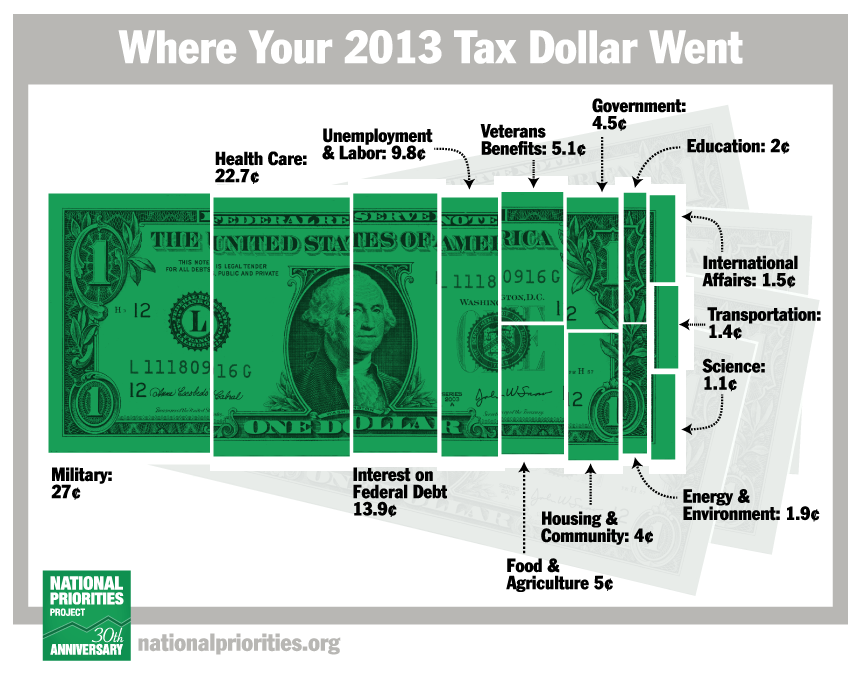
So why are we spending so much on defence and so little on education? In 2013 NationalPriorites.Org showed below how the American Dollar was spent that year :

https://static.nationalpriorities.org/images/charts/2015/taxes-desk.png


So 27% was Military spending while 2% was spent on Education (truth) and 5% on Food and Agriculture and 4% on Housing and Community (plenty). This seems to be out of proportion to need. Health Care (love), one of the biggest spends, still isn't as much as military spending.

Military and Veteran Benefit costs are nearly the same as the costs Health Care, Education, Food and Agriculture and Housing and Community combined. Imagine if the 33% spent on war was instead spent on peace and all its associated truth, love and plenty. The money could be spent on lessening fears whether related to war, or ignorance, or pain or deprivation and help promote the ideals and reality of peace, truth, love and plenty.
It won't happen overnight but we can begin with ourselves and finding the good that is in us all, spread that good and share that good. Look for it in others. Realise that taking a life out of the equation, whether someone else's or our own will not help us to find answers. That we all deserve peace, truth, love and plenty. 

We know the phrase - 'You are your own worst enemy.' Does that mean I am my own Room 101?


References:

McLeod, S. A. (2009). Eyewitness Testimony.
Orwell, G. (1949, 2013) Nineteen Eighty Four, Penguin Classics
Powell, C. (20013) Full Text of Colin Powell's Speech, The Guardian
Tversky, B. & Fisher, G. (1999) The Problem with Eyewitness Testimony 
Tavernise, S. (2013) To Reduce Suicide Rates New Focus Turns to Guns, New York Times, February 13
Radcord, B. (2013) Is Suicide a More Present Danger Than Murder? Psychology, Discovery 

Sunday, 28 September 2014

History Repeating

I marched in 2003/4 with the students of our school and I will be protesting again this coming Saturday the 4th of October.

Why ? Check out why Stop the War Coalition think Iraq and Syria should not be bombed.

As Franklin D. Roosevelt said 'Repetition does not transform a lie into a truth.'

~