Showing posts with label superstition. Show all posts

Saturday, 8 August 2015

Hawthorn, Superstition and Death

I remember giving my mother a bunch of hawthorn flowers and being warned to take them out of the house as they were bad luck. I remember taking them out and planting them uselessly in the ground taking it as true because my mother told me. 

This was an Irish superstition, it seems since the middle ages. Hawthorn could adorn the outdoors but to bring it into the house would signify death.

The book Under the Hawthorn Tree by Marita Conlon-McKenna, certainly has much to say about death as a book about children trying to escape the workhouse at the time of the Irish Famine. People were dying all round them and their baby sister was buried where they used to play, under the hawthorn tree.

The origin of the link with death associated with the hawthorn, it seems began when it was said that the flowers smelled like the plague. In later years, according to Trees for Life,  botanists discovered that the hawthorn flower has the chemical trimethylamine which is also a chemical made by decaying flesh. This was a smell people were used to when copses were kept in the house for days before burial and makes sense of the link made between hawthorn and death.

So although I like the blossom of the hawthorn, it won't be adorning the rooms of my house. Not because of any superstition or bad luck, but because I just don't happen to like the smell of rotting flesh, even from a flower.

Friday, 13 March 2015

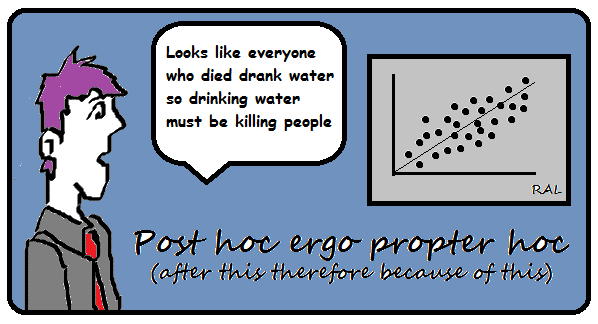
On Superstition: Post Hoc Fallacy

Much superstition comes from the post hoc fallacy, when people think that because something happened after another thing, that it happened because of it (Logical Fallacies). This is the case in everything from people wearing lucky socks (or pants) to more serious inferences which have caused mistakes and delays in medical diagnoses.


'Are we not all apt to assume too easily that because something follows something else it must be due to it?'
Rudolf (1938, p.281) speaks of the 'infinite regress' when looking for the cause of pneumonia, and whether it was the pneumococcus, or chill creating conditions, or why the patient got the chill (sleeping in a ditch), or why he slept in a ditch (because he was drunk) or why he got drunk (because he won some money). Of course it makes no sense to say that pneumonia is caused by winning money, but how far back in the chain of events must we go for the cause?

Rudolf (1938) talks about malaria's development in history from being evil spirits which entered the body from the mists around marshes and stagnant pools of water to being caused by the mosquito of those parts (p.282). Some answers can be right for the wrong reasons, such as in ancient history when it was found that cinchona relieved fever, which was seen as driving out the evil spirit (Rudolf, 1938, p.283). If as Rudolf, suggests, we replace the words 'evil spirit' with 'infecting agent' we can see that these primitive diagnoses where right, just for the wrong reasons (Ibid).

So, at times, in absence of a cause that we can identify (or understand) we can instead replace a cause with something merely related or in the language and context we do understand. Mists have evil spirits that can cause malaria and if I wear my lucky socks my team will win. Neither my socks or evil spirits will have any effect on my team winning or getting malaria. Or crossed fingers or knocking on wood. One does not cause the other.

Rudolf (1938, p.282) contends that nothing causes the other but that it is just an overlapping of time lines with a result, he tells us there is no answer to the question:

'Which came first, the chicken or the egg?'

I would agree in this context, however do think that, as dinosaurs laid eggs and they existed before chickens, that in an evolutionary context, the egg came first!
 .
Rudolf, R. D. (1938) The Post Hoc Ergo Propter Hoc Fallacy in Medicine, Canadian Medical Association Journal, 1938 Mar; 38(3): 281–284


Related posts:
More examples of Post Hoc Fallacy in About Education

Wednesday, 11 March 2015

On Superstition: The Profit/Prophet in Smoking

Kids' Messages in Art for the People they Love who Smoke
Why Do People Smoke? 

According to ASH (Action on Smoking and Health)  smoking has been around since 1 BC when it was used for 'medicinal and ceremonial purposes' and the first time there is pictorial evidence of tobacco being smoked is on Guatemalan pottery from a vase from 600-1000 AD. According to Smoking with Gods, the Mayan culture associated smoking and smoke with its Gods, in its art, history and religion. Capnomancy is the name of the method of divination by smoke, kapnos being the Greek for smoke and manteia the Greek for prophecy  (Wikipedia).

As well as smoke's great powers of prophecy and in religious ceremony, it was seen as having medicinal properties. In Spain, in 1571 smoking was considered to cure 36 different 'maladies' and in 1577 it was recommended for toothache, worms, halitosis, lockjaw and cancer. At the time of the plague from the 1660s to early 1700s, smoking was thought of as a prevention method and school masters whipped their pupils in Eton if they did not smoke! (AJ. Bell)

It is not surprising then to find that tobacco became popular (even leaving out its addictive properties). No we are not surprised. This is how we understand tobacco's place in popular culture to have come about. Even when people stopped believing in the 'medicinal'  qualities, it still had a traditional draw which associated it with wellbeing and made it aspirational and 'cool' (ACS). And after all, was it not just in recent years we found out about it's dangers?

Not so. 400 years ago in 1604, King James I of England said smoking was 'harmful to the brain, dangerous to the lungs'. So why did it take another 400 years for legislation to catch up? Because it was and is profitable. In fact King James, instead of making this 'harmful' and 'dangerous' custom of smoking unlawful, he imposed a heavy tax on it and made a profit.

Meanwhile people smoked and people died. Even people who didn't smoke were affected. From adults in bars to children in cars, people were and are still in many places suffering the effects of passive smoking. The exposure of children to second hand smoke dropped by nearly 60% from 1996 to 2006 in the UK with such smoking laws as began in Ireland in 2004. However, until 2007 children could still smoke from the age of 16. In the UK 600 children start smoking every year and although the number of over all smokers in the population has dropped below 20% that is still 1 person in every five people.

So, what started as a superstition over a thousand years ago for its medicinal and ceremonial values to see the Gods in the rising smoke, is still with us. Smoking is still with us and still killing us. A sort of self-harm that brings us closer to death. Maybe that's how smoking works, it helps us see our Gods... sooner.

ASH (2014) Key Dates in the History of Anti-tobacco Campaigning, http://www.ash.org.uk/files/documents/ASH_741.pdf