Showing posts with label Orwell. Show all posts

Friday, 6 May 2016

On Writing: The Deadly Art of Euphemism

Orwell, in 1945, speaks about the language of politics at a time when the second of two world wars is coming to an end. He contends that 'political speech and writing are largely the defence of the indefensible', of such acts as 'British rule in India', 'Russian purges and deportations' and 'the dropping of the atom bombs on Japan' (1945, 2013, p.14). He argues that it is impossible to defend such indefensible acts without the use of euphemism (ibid). Little has changed in the intervening years, the indefensible still happens but the euphemism might have changed. Some examples Orwell discuses are:

  • When defenceless village people are bombed by planes, driven out and their homes and livestock destroyed this is called 'pacification' (Ibid).
  • When millions of deprived people are made homeless, without much more than what is on their backs and made to seek out help further afield, this is called 'transfer of population or rectification of frontiers' (Ibid).
  • When people are put in prison for years without trial or shot or die in labour camps, this is called 'elimination of unreliable elements' (Ibid).

How many times have we heard euphemisms such as this since then? We've heard them for the wars, occupations, deportations, shootings, imprisonment and destruction of peoples' lives and livelihoods.

As Conor Lynch points out, the most infamous of these euphemisms is 'collateral damage' meaning in simple terms 'the killing of innocent civilians' (2016). Lynch reminds us of the  invasion of Iraq in 2003 (which we marched in protest against). This invasion was code named 'Operation Iraqi Freedom', a euphemism which sounded nothing like 'invading for oil or promoting market/ideological interest' resulting in civilian casualties of between '139,934 and 158,483' (Ibid).

As Orwell puts it:

'Political language […] is designed to make lies sound truthful and murder respectable and to give an appearance of solidity to pure wind'
(Orwell, 1945, 2013, p. 20)

Lynch, C. (2016) Election 2016: 6 of the Most Meaningless Words that Politicians and Pundits Throw Around and Should be Banned [Online] Available at: http://www.alternet.org/election-2016/6-most-meaningless-words-politicians-and-pundits-throw-around-and-should-be-abandoned
Orwell, G. (1945, 2013) Politics and The English Language, Penguin Books

Thursday, 14 April 2016

Shooting an Elephant: Acting Foolishly to Avoid Appearing Foolish

How likely is it that we might revert to the animal instinct of not showing weakness in case we are pounced upon?

Orwell (1936) in his story Shooting an Elephant describes a British Officer's experience in Burma, when as a representative of British rule and authority, he was called upon, by 'an unarmed native crowd', to shoot an elephant (p.95). Even though he did not think it was necessary, because it was expected of him, he did. And he did it 'solely to avoid looking a fool' (p.99)

He was 'only an absurd puppet pushed to and fro by the will of [others]' he said and 'wears a mask and his face grows to fit it' (Orwell, 1936, p.95)

How much do we do because of what is expected of us or to avoid appearing foolish or to maintain hegemony or a status quo? How much are we reverting to the animal instincts of not showing weakness?

The chimps of Gombe studied by Goodall, are unable to control their facial features and when they are afraid make a 'fear grimace' (Hall & Dawson, 1998, p.31). A chimp displaying such a 'fear grimace' will cover his face with his hands,  lest it be recognized as weakness and he is attacked by a rival (Ibid).

Are we constantly trying to hide our real emotions and live up to expectations, living in fear of showing weakness and being attacked? 

How much do we go against our better judgements to maintain the status quo? What would it take for any one of us to end up shooting an elephant?

Hall, M. E. and Dawson, P. (1998) The Submission Reflex, Nova Publishers.
Orwell, G. (1936, 1957) Shooting an Elephant, Inside the Whale and Other Essays, Penguin

Tuesday, 5 May 2015

Hundred Dollar Monopoly

As this is my hundredth post I wondered what to write and thought 100 should feature in some way. Tonight at the youth centre where I work, I mentioned playing speed-Monopoly,  aka Hundred Dollar Monopoly, and my colleague suggested I could write about that, because of the 100 but also because its an example of how we adapt our resources to needs. 

I remember playing Monopoly as a child, and wanting to play it more than I did. It was one of those games that held mystery and because it had so many components and was played so rarely it maintained the mystery for years. My favourite piece was the boot and when myself and my three brothers played it was taken for granted that was my piece. We never really read the rules and relied on parents and common sense to get us through. That didn't get us far and most games were abandoned in frustration rather than played to the end. But there was something magical about the game, not least because it was expensive and not everyone could afford it so was one of those games we were lucky to have.

Having younger brothers who's attention span was limited meant we sometimes made up our own rules, as all children do. I can't remember them but they made sense to us then. I look at the children's versions of games like Monopoly, Cluedo and Scrabble that are around today and I know we would not have appreciated them. We wanted to play the grown up game, even if we did make up our own rules.

There is something about the money as a child which is enthralling. I see it exactly the same with the children I work with. The property aspect goes over most heads, its the money that attracts them. The best part always seems to be when you get your money and everyone has the same, and when you get more, its better but one disadvantage of winning more money, especially if you are enjoying the game, is that the more you win, the closer the game comes to the end. And when you have invested in the game and see this happening, it starts to lose its appeal. I remember, in particular, occasions when one person had had the luck of the draw and seemed to have hotels on all the most expensive properties and was winning hands down, the joy of the game was lost for them, as the competition was over and was certainly lost for those losing.

So I know the game of Monopoly and have seen many games to their ends, which I suspect is not the case with many other people. I imagine more games are abandoned and adapted than actually played to the end by the rules (its certainly the case in our youth centre). So when the young people wanted to play a game recently I invented my version of speed-Monopoly called Hundred Dollar Monopoly. I'm sure I didn't invent it, and probably cobbled the idea from other versions and previous made-up-rules from childhood. But if you do want to play a fast game within a limited time frame, and you don't want the outright winner to leave everyone in the dust, here are the rules:

Hundred Dollar Monopoly

Rule 1: Everything is $100
  • Rent = £100
  • Fines = $100
  • Costs/prizes = $100
  • Get out of Jail = $100
  • Cheating = $100
  • Being Mean = $100
  • Everyone is given 10 x $100 bills
  • All the property cards are divided out, 3 of which can be bought/sold for £100 each
Rule 2: There are only 2 ways to make more than $100
  • By passing go - collect $200
  • By landing on Car Park & collecting any fines placed in the centre 

At the end of the prescribed time the money is counted up and whoever has the most wins.
My partner commented that I seemed to have invented Communist Monopoly, something of an oxymoron. And yes is is veering away somewhat from its Capitalist roots. It does seem to start with an even distribution of wealth and although there is a winner, it doesn't have to be at the expense of others, where one ends up with everything and the others nothing. Everyone seems, at the end, to have an adequate amount of money, only some more than others. And everyone still has most of their property, and none of that property is of more value than the next. I did a quick Google to see if there was a Communist Monopoly and found Kolejka (Queue) a Polish game based on Monopoly showing much of the down side of Communism. I suppose it is much like the trouble with Orwell's Animal Farm where at first on the wall were the words:

'All Animals are Equal.'

Which, over time, as ideals fell to the wayside of greed, the rule changed to:

'All Animals are Equal...but Some are More Equal than Others.'

This then is where the fines for 'being mean' or 'cheating' come into the game, and fits in with modern day socialist theory which finds social justice high on the agenda of Socialism, and is certainly high on the agenda of any youth worker worth their salt.

So it will be interesting to see if Hundred Dollar Monopoly develops any more rules and if they veer it more  towards Capitalism or Socialism. Of course the next step would be to create our own version which has shared property and resources and traded skills and the winner being the one who helped people the most and did the most to make the world a better place. Maybe a bit much to ask from a board game, but hey,  I didn't think I'd get to 100 posts either!

Thursday, 19 February 2015

Reflection on Reading

Having just finished The Year of Reading Dangerously by Andy Miller, and how 50 Books changed his life as a person and as a writer, I considered the books I have read recently and their influence on me. If as Stephen King says, in reading books we find the tools for writing, then I should be a better writer the more I read.
Page Opened at Random in To The Lighthouse by Virginia Woolf
With this in mind below is a list of what I have been reading (and why) since September when I started this blog. As Miller and Stephen King contend, this should influence my life and what I write. This can most obviously be seen in this post, and anywhere I have mentioned the books below, but I wonder how much of what I've written has been influenced in subtle ways I don't realise.

52 Quotes List of Books:

1.  Rebecca by Daphne Du Maurier. This was a Book Club book. I'd joined the book group to keep in touch with a friend and to push myself into reading books I wouldn't read otherwise. However this was a book I'd read years ago and I'd also seen the 1940's film with Laurence Olivier and Joan Fontaine. Even so, I'd completely forgotten the plot (a gift of mine which means I can enjoy again and again) and only remembered the haunting atmosphere created in both book and film. It has one of my favourite openings of all time, which encompasses the whole trial of what is to come in the rest of the book.  'Last night I dreamt I went to Manderley again' hints at a momentous time in our heroines life but it is only if we read on we find out why.

2.  Make Good Art by Neil Gaiman. This was a lecture Gaiman gave to students at Philadelphia's University of the Arts in 2012. This book is innovatively illustrated by the graphic artist Chip Kidd, with a play on words and typography throughout. In it he tells us: 'Go and make interesting mistakes, make amazing mistakes, make glorious and fantastic mistakes. Break rules. Leave the world more interesting for your being here.' More on Gaiman and mistakes in 10 Reasons We Should Make Mistakes. A thoroughly inspiring speech and book for anyone trying to 'make good art', or just anyone.

3. Stephen Fry, Selection of Anton Chekov's Short Stories  Recommended by L, a friend of mine, I have tried to read Chekov before and never quite grasped the tone until listening to Stephen Fry. It was a pleasure and delight and I laughed at the brilliantly painted scenes and dialogue which came to life with Fry's voice and vitality.

4. Life after Life by Kate Atkinson. This was another Book Club book, with an interesting premise of following the lifes and deaths of Ursula, and the many variations of lives lived. It reminded me of Schrödinger’s Cat, and how we the readers get to look inside the box. It also prompted a friend to recommend The First 15 Lives of Harry August by Claire North, which I read later and comment on below.

5. & 6. Out of the Ashes and Adolphus Tips by Michael Murporgo, were books we had in our centre library and ones which I thought short enough not to put off a young person into her first foray into personal reading. When I suggested, as part of her alternative curriculum, that we read a book, M asked me why. Yesterday,  having read a number of books, M wanted to know when we were reading the next, she was looking forward to it!

7. Regeneration by Pat Barker. This book was chosen as the book to read, by the library community book group, for around the time of Remembrance Day. The book was memorable, as an exploration of the mental battles soldiers and doctors fought in and out of the trenches of the first world war. The psychological effects of warfare are treated in a hospital, using methods from counselling to electroshock therapy, all in an effort to get the men back in the trenches. It reminded me of Catch 22 by Joseph Heller. Catch-22 told the story of how those who were proven to be insane were relieved of duty. The idea was that you would have to be mad to constantly fly into almost certain death, over and over again, but if you asked to be relieved of that duty, that would prove you sane, so hence the term 'catch-22' - there was no getting out of it. Another story about the insanity of war.

8. The Boy in the Striped Pyjamas by John Boyne. This was another book in our young person's book club. I chose it because, like the other two books, it was first person narrative, which M was able to identify with. I had to cover the book so that the cover picture would not give away the plot and so that M's reading wouldn't be ruined by spoilers because people would be familiar with the name of the book. For some time M just called the book, the yellow book, because of its yellow cover. Usually I am not so cautious but I had seen Of Mice and Men spoiled for M at school and didn't want to take any chances.  This was the first book M could not put down.

9. Maggot Moon by Sally Gardner. I chose this book as research for my main character in my novel. I needed to figure out his age and the appropriate first person narration for that age. Moon boy was far too young which I was glad of as I had been afraid my character seemed young, but was reassured. The story itself had a great worldview, reminding me of a children's version of 1984 by George Orwell, and had a great version of moon-landing propaganda. This was also the beginning of my training in listening to an audio version of a book. I'd not quite got the hang of it before and I wanted to try again.

10. Wonder by  RJ Palacio. This was another research book for my novel, but again the narrator, aged ten was too young. What was especially interesting though was that we didn't just get the experience of the central character August and what it was like to negotiate a new school life with a facial disfigurement but we also got that story narrated from the points of view of the other people in his life, giving the novel layers, multiple perspectives and a depth of understanding of life which is normally impossible from just the one point of view. What also added texture to the audio narration was the different voices for the different characters. I was finally getting the hang of audio books.

11. On Writing: A Memoir of the Craft by Stephen King. This I read for obvious reasons. And I read it and didn't listen to it. Mainly because I bought it last year in the New York City Library (I even got it stamped!) and had bought it for the motivation and inspiration I knew I needed for my next stage as a writer.  Yesterday's Fear was a post where I describe some inspiration I got from the book. However, the best lesson I got from reading the book was that there is time to write. If someone could write between the wash cycles of an industrial laundromat I certainly can find time to write.

12. 1984 by George Orwell. I read this years ago in my final years at school, probably even in 1984. I wanted to revisit it, after reading Maggot Moon and also as research for the alternative worldview of my novel, to check what I was missing. I decided this time to listen to it, trying to train myself to be able to listen/read at times when I usually wouldn't be able to pick up a book, like walking to work, shopping, cleaning. I was amazed by how much time I could reclaim for reading. A brilliant revelation. Room 101: We Are Our Greatest Fear is a post based on what I read, but it really only barely scratched the surface of what I learned every time I've read it. Still what resonates with me is how words hold power, how they mould thought and control the masses in a sort of mind control of our own making.

13. & 14. & 15. Divergent, Insurgent, and Allegiant  the trilogy by Veronica Roth, was again reading for YA research. I'd seen Divergent, the film and liked the main character Tris and the way the world was split into factions, different groups promoting the skills and characteristics of five virtues: selflessness, peacefulness, bravery, honesty and intelligence. This was again a first person narrative and from the perspective of a 16 year old Tris (a similar age to my main character) who has to chose her path in life and finds it to be divergent. I listened to all three books, read by Emma Galvin as Tris and was able to move the speed of narration from 2.5 of the previous book to 3. I was reading now all the time and getting through books in no time.

16. The Children Act written by Ian Mc Ewan, read by Lindsay Duncan. A brilliant book, brilliantly read by Lindsay Duncan (who years ago, when my partner briefly dipped his toe in the shallow and unprofitable end of script-writing, played a part in a short film he wrote, called Late at the Office). The Children Act is something I'm familiar with from a legal perspective as I work with children and young people and much of what McEwan had to say really hit home with me. The Cement Garden and On Chesil Beach came to mind at times reading this book, not least because they are other great stories from McEwan but they spark moral dilemmas and raise questions about what it means to be a man, woman or child trying to find our ways in the world in our intricate networks of people, situations and feelings, and the sometimes slow, sometimed fast, domino fall of consequence.

17. Extremely Loud and Incredibly Close by Jonathan Safran Foer.  I began listening to this and loving Oskar as a character, laughing out loud, as he described his encounter with his jujitsu teacher and was really excited to get to know this character. Slowly but surely, the book sucked the life and joy out of Oskar and made him into a caricature, nothing like a real 9 year old. I watched the film to see if I'd missed something, but the film made the Oskar character even more unlikeable. I was disappointed, he was not believable, the other characters all seemed more realistic than Oscar, so I lost faith in his truth and in the end only believed them.

18. The First Fifteen Lives of Harry August by Claire North. This book had some interesting concepts and time-travel themes. It set the scene and set out the rules at the start, and went headlong into a battery of lives and life and world events and then faded a bit in the middle, with a barrage of more of the same and constant digressions but picked up again at the end. It seemed to come together with the plot of the Cronos Club, which without would have been just a string of lives and deaths. But it did come to a satisfactory ending and was worth sticking with.


I wonder what my reading says about me. Or more importantly I wonder what my writing says about my reading. I have certainly learned more than I've read. In the end I can't say how much I have been influenced by what I've read, as my very thinking, language and writing of it will be shaped in ways I cannot separate from my thinking, language and writing. When I reflect on my reflection its no longer the same relection. Its like holding a mirror and seeing the opposite. Its not me, just me looking at me.

Thursday, 29 January 2015

Room 101: We Are Our Greatest Fear

Am I Winston Smith or a Prole? I don't know. I don't even know which I'd prefer to be. Would I prefer to live in ignorance or knowledge of the control others have over me? Do I have to know what freedom is to have it? And when we know what it is, is that when we realise we don't have it.
Does that make the slogans in the totalitarian state of Nineteen Eighty-four true? Is it true that Freedom is Slavery? Is it true that Ignorance is Strength? Are we more able to cope the less we know of the evils and hardships of the world? Does knowledge bring fear? 

Fear can hold us back, and make us appear weak. Or the opposite. You bring your guard up. To protect you attack. Is this what is meant by War is Peace? To preserve peace we go to war?

Of course everything is true and not, depending on the context. I could outline a number of examples to prove the case either way. But that would be Doublespeak. For instance, I might not want freedom, to think for myself. I might prefer to submit to the powers that be and live in ignorance, protected from the big bad wolf they remind me of. So I may be a slave to the convention, religion, rule or law enforced but have the freedom that comes with no responsibility. Or as the Goldstein’s Manifesto says 'the consciousness of being at war, and therefore in danger, makes the handing-over of all power to a small caste seem the natural, unavoidable condition of survival'.

So where is our Freedom? What part of our lives is not controlled from outside, whether by convention, religion, law or rule?

Nothing is our own we are told in 'except a few cubic centimetres' inside our heads but we are tested on that regularly whether in SATs tests or in conversation or the way we live our lives in general where if we do not adhere to the norm we are cast out. Its the Garden of Eden all over again. Big Brother and the Thought Police were there as they were in Winston's world, as they are in ours.

And the media and historians write their versions of events, as the party slogan in Nineteen Eighty-four went:

'Who controls the past controls the future: 
who controls the present controls the past.'

Nothing can ever be entirely accurately and objectively recorded. The very act of observation changes it to a subjective act. Eye witness accounts in court rooms are notoriously inconsistent with each other and documentary evidence.

This happens even without conscious intention. Imagine then what can happen when the intention is there. Propaganda like 'weapons of mass destruction'. Propaganda is a weapon of mass destruction. We manage to live in fear avoiding real life world issues such as deprivation and inequality while we protect what we are lucky to have from what appears to be a foreign threat.

We don't want the Proles or Winstons of the world to be educated to the point where we work this out for our selves. We will be harder to control. So our knowledge and education is limited by controlling measures such as charging fees for university (a financial control barrier) or by limiting our vocabulary and range of thought processes with Newspeak.

Don't you see that the whole aim of Newspeak 
is to narrow the range of thought? 
In the end we shall make Thoughtcrime literally impossible, 
because there will be no words in which to express it.

So if we can't express ourselves we cannot revolt. Of course as Winston said we cannot rebel until we become conscious or become conscious until we break the mould with rebellion.

So the world was round and flat at different times. Winston asks is a lunatic just a 'minority of one?' Just a non conformer. Just because everyone else thinks it – it doesn't make it so.

'Being in a minority, 
even a minority of one, did not make you mad. 
There was truth and there was untruth, 
and if you clung to the truth even against the whole world, 
you were not mad.'

What if our selfishness and greed was wiped out in evolutionary terms, in wars and murders. Could we evolve as humans to be able to life in peace, truth, love and plenty (the ironic names of the ministries which were in opposition to the promotion of those ideals). What if our goal in life was 'not to stay alive but to stay human'? Would we get better at it? Could we learn to be better humans rather than live in fear of what is outside ourselves?

Of course, as O Brien tells us, everyone knows what’s in the dreaded Room 101:

'The thing that is in Room 101 is the worst thing in the world.'

Anyone's Room 101 will contain their greatest fear. For Winston it would appear to be rats. However there weren't just rats in the room. There was also O'Brien and Winston. Winston, himself and another human being. Was his greatest fear in fact, the human... and perhaps even himself?

While we fear other humans and focus our energies on them, we don't on ourselves. While security in buildings and airports is ramped up and we buy more guns to protect our homes or we go to war to protect our 'way of life' we fail to see the real dangers. Ourselves. We are more likely to use a gun to kill ourselves than ever have someone else kill us with a gun. The states in the US with the highest rates of gun ownership are also the states with the highest suicide rates (Tavernise, 2013). 'Nearly a third more people die at their own hands than at other people’s' (Radford, 2013) but media still hypes a different view.

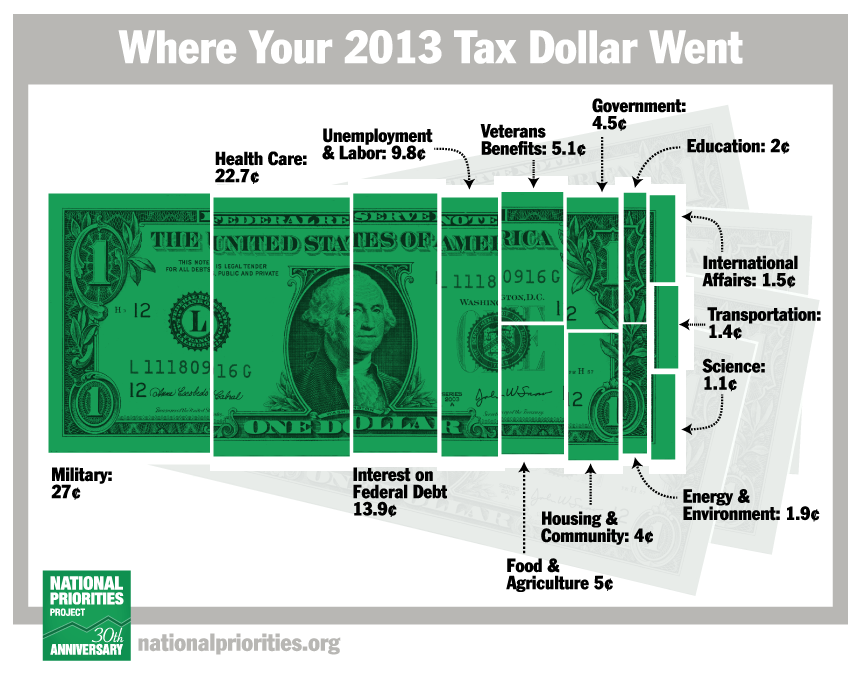
So why are we spending so much on defence and so little on education? In 2013 NationalPriorites.Org showed below how the American Dollar was spent that year :

https://static.nationalpriorities.org/images/charts/2015/taxes-desk.png


So 27% was Military spending while 2% was spent on Education (truth) and 5% on Food and Agriculture and 4% on Housing and Community (plenty). This seems to be out of proportion to need. Health Care (love), one of the biggest spends, still isn't as much as military spending.

Military and Veteran Benefit costs are nearly the same as the costs Health Care, Education, Food and Agriculture and Housing and Community combined. Imagine if the 33% spent on war was instead spent on peace and all its associated truth, love and plenty. The money could be spent on lessening fears whether related to war, or ignorance, or pain or deprivation and help promote the ideals and reality of peace, truth, love and plenty.
It won't happen overnight but we can begin with ourselves and finding the good that is in us all, spread that good and share that good. Look for it in others. Realise that taking a life out of the equation, whether someone else's or our own will not help us to find answers. That we all deserve peace, truth, love and plenty. 

We know the phrase - 'You are your own worst enemy.' Does that mean I am my own Room 101?


References:

McLeod, S. A. (2009). Eyewitness Testimony.
Orwell, G. (1949, 2013) Nineteen Eighty Four, Penguin Classics
Powell, C. (20013) Full Text of Colin Powell's Speech, The Guardian
Tversky, B. & Fisher, G. (1999) The Problem with Eyewitness Testimony 
Tavernise, S. (2013) To Reduce Suicide Rates New Focus Turns to Guns, New York Times, February 13
Radcord, B. (2013) Is Suicide a More Present Danger Than Murder? Psychology, Discovery