Showing posts with label Peace. Show all posts

Wednesday, 12 August 2020

Duck and Cover

Duck and Cover was one of the winning stories performed by the wonderful Lin Sagovsky at the 'Women and Girls' Liars League event on August 11th.

Read it or listen to it here or watch 👇

Thursday, 30 June 2016

Finger Pointing

The old adage about every time you point a finger at someone there are three pointing back at you tries to prevent a blaming culture and have us all take responsibility.

Sometimes though, we need to point fingers. 

Sometimes we just need to say things, because they need to be said.

Bob Dylan said his song Blowing in the Wind, wasn't a 'protest song' because he didn't write protest songs, he said:


'I'm just writing it as something to be said, for somebody by somebody.'
 (Cited by Peter Dreier  in The Political Bob Dylan,  Dissent, 2011).

Blowing in the wind has its questions and answers which are unspecific to a time, people or place. The answers are 'blowing in the wind'. It is up to us to recognise or find them.

Sometimes though we need to point fingers, as Dylan said:

 'you know pointing to all the things that are wrong.' 
(Cited by Jon Bream in Dylan: Disc by Disc, 2015)
Things like war, inequality and injustice. Whether it is the Vietnam or Iraq war or Civil Rights in the US in the 60s or the racism of Brexit in the UK today.

Rolling Stone has a Ten Best Protest Songs of All Time list. As do most music media sites. My favourites include the following ones (in no particular order) from my childhood and since:
  1. Imagine by John Lennon
  2. Feed the World by Band Aid
  3. In the Ghetto by Mac Davis and sung by Elvis
  4. Give Peace a Chance by Toots and the Maytales
  5. Get Up Stand Up by Bob Marley
  6. Talkin Bout a Revolution Tracy Chapman
  7. Between the Wars by Billy Bragg
  8. Another Brick in the Wall by Pink Floyd
  9. Where is the Love? By Black Eyed Peas
  10. Zombie by The Cranberries
  11. Big Yellow Taxi by Joni Mitchell
  12. This Land is Your Land by Woodie Guthrie
  13. And the Band Played Waltzing Matilda and 14. The Green Fields of France by Eric Bogle
As I write this I happen to be wearing a Tshirt with Bob Marley's Get Up Stand Up emblazoned across it and just now listened again to Bragg's  Between the Wars in tears. We should be upset. We are still battling for a living wage in the UK and still seeking justice and equality in so many ways. We should be singing songs like this.

One of the lines which has always caught me is Manic Street Preachers':
'If you tolerate this your children will be next.'

This reminds me always of the words from Martin Niemöller I spoke of in my post Never Doubt:

First they came for the Socialists, and I did not speak out—
Because I was not a Socialist.

Then they came for the Trade Unionists, and I did not speak out—
Because I was not a Trade Unionist.
Then they came for the Jews, and I did not speak out—
Because I was not a Jew.
Then they came for me—and there was no one left to speak for me.

In a Guardian article Jonathan Luxmorre and Christine Ellis (2016) ask 'where are all the protest songs?' Sadly I wonder if they have all already been written and performed and we are just waiting for people to finally hear them.

Friday, 6 May 2016

On Writing: The Deadly Art of Euphemism

Orwell, in 1945, speaks about the language of politics at a time when the second of two world wars is coming to an end. He contends that 'political speech and writing are largely the defence of the indefensible', of such acts as 'British rule in India', 'Russian purges and deportations' and 'the dropping of the atom bombs on Japan' (1945, 2013, p.14). He argues that it is impossible to defend such indefensible acts without the use of euphemism (ibid). Little has changed in the intervening years, the indefensible still happens but the euphemism might have changed. Some examples Orwell discuses are:

  • When defenceless village people are bombed by planes, driven out and their homes and livestock destroyed this is called 'pacification' (Ibid).
  • When millions of deprived people are made homeless, without much more than what is on their backs and made to seek out help further afield, this is called 'transfer of population or rectification of frontiers' (Ibid).
  • When people are put in prison for years without trial or shot or die in labour camps, this is called 'elimination of unreliable elements' (Ibid).

How many times have we heard euphemisms such as this since then? We've heard them for the wars, occupations, deportations, shootings, imprisonment and destruction of peoples' lives and livelihoods.

As Conor Lynch points out, the most infamous of these euphemisms is 'collateral damage' meaning in simple terms 'the killing of innocent civilians' (2016). Lynch reminds us of the  invasion of Iraq in 2003 (which we marched in protest against). This invasion was code named 'Operation Iraqi Freedom', a euphemism which sounded nothing like 'invading for oil or promoting market/ideological interest' resulting in civilian casualties of between '139,934 and 158,483' (Ibid).

As Orwell puts it:

'Political language […] is designed to make lies sound truthful and murder respectable and to give an appearance of solidity to pure wind'
(Orwell, 1945, 2013, p. 20)

Lynch, C. (2016) Election 2016: 6 of the Most Meaningless Words that Politicians and Pundits Throw Around and Should be Banned [Online] Available at: http://www.alternet.org/election-2016/6-most-meaningless-words-politicians-and-pundits-throw-around-and-should-be-abandoned
Orwell, G. (1945, 2013) Politics and The English Language, Penguin Books

Monday, 18 May 2015

Things That Matter: Equality

'Our lives begin to end the day we become silent about things that matter.'
 (Martin Luther King, cited by Halligan, May 16th 2015, Irish Times)


Irish Tv journalist and political correspondent, Ursula Halligan ended a 54 year silence with the above quote. With the Irish referendum on marriage equality only days away, Halligan revealed her secret self, which had been hidden away in a diary from when she was 17.  She hopes her story will not only help get a YES vote for marriage equality, but save other 17 year olds like her from the pain of repression, injustice and inequality.

Read Article here: Ursula Halligan: Referendum led me to tell truth about myself

Thursday, 29 January 2015

Room 101: We Are Our Greatest Fear

Am I Winston Smith or a Prole? I don't know. I don't even know which I'd prefer to be. Would I prefer to live in ignorance or knowledge of the control others have over me? Do I have to know what freedom is to have it? And when we know what it is, is that when we realise we don't have it.
Does that make the slogans in the totalitarian state of Nineteen Eighty-four true? Is it true that Freedom is Slavery? Is it true that Ignorance is Strength? Are we more able to cope the less we know of the evils and hardships of the world? Does knowledge bring fear? 

Fear can hold us back, and make us appear weak. Or the opposite. You bring your guard up. To protect you attack. Is this what is meant by War is Peace? To preserve peace we go to war?

Of course everything is true and not, depending on the context. I could outline a number of examples to prove the case either way. But that would be Doublespeak. For instance, I might not want freedom, to think for myself. I might prefer to submit to the powers that be and live in ignorance, protected from the big bad wolf they remind me of. So I may be a slave to the convention, religion, rule or law enforced but have the freedom that comes with no responsibility. Or as the Goldstein’s Manifesto says 'the consciousness of being at war, and therefore in danger, makes the handing-over of all power to a small caste seem the natural, unavoidable condition of survival'.

So where is our Freedom? What part of our lives is not controlled from outside, whether by convention, religion, law or rule?

Nothing is our own we are told in 'except a few cubic centimetres' inside our heads but we are tested on that regularly whether in SATs tests or in conversation or the way we live our lives in general where if we do not adhere to the norm we are cast out. Its the Garden of Eden all over again. Big Brother and the Thought Police were there as they were in Winston's world, as they are in ours.

And the media and historians write their versions of events, as the party slogan in Nineteen Eighty-four went:

'Who controls the past controls the future: 
who controls the present controls the past.'

Nothing can ever be entirely accurately and objectively recorded. The very act of observation changes it to a subjective act. Eye witness accounts in court rooms are notoriously inconsistent with each other and documentary evidence.

This happens even without conscious intention. Imagine then what can happen when the intention is there. Propaganda like 'weapons of mass destruction'. Propaganda is a weapon of mass destruction. We manage to live in fear avoiding real life world issues such as deprivation and inequality while we protect what we are lucky to have from what appears to be a foreign threat.

We don't want the Proles or Winstons of the world to be educated to the point where we work this out for our selves. We will be harder to control. So our knowledge and education is limited by controlling measures such as charging fees for university (a financial control barrier) or by limiting our vocabulary and range of thought processes with Newspeak.

Don't you see that the whole aim of Newspeak 
is to narrow the range of thought? 
In the end we shall make Thoughtcrime literally impossible, 
because there will be no words in which to express it.

So if we can't express ourselves we cannot revolt. Of course as Winston said we cannot rebel until we become conscious or become conscious until we break the mould with rebellion.

So the world was round and flat at different times. Winston asks is a lunatic just a 'minority of one?' Just a non conformer. Just because everyone else thinks it – it doesn't make it so.

'Being in a minority, 
even a minority of one, did not make you mad. 
There was truth and there was untruth, 
and if you clung to the truth even against the whole world, 
you were not mad.'

What if our selfishness and greed was wiped out in evolutionary terms, in wars and murders. Could we evolve as humans to be able to life in peace, truth, love and plenty (the ironic names of the ministries which were in opposition to the promotion of those ideals). What if our goal in life was 'not to stay alive but to stay human'? Would we get better at it? Could we learn to be better humans rather than live in fear of what is outside ourselves?

Of course, as O Brien tells us, everyone knows what’s in the dreaded Room 101:

'The thing that is in Room 101 is the worst thing in the world.'

Anyone's Room 101 will contain their greatest fear. For Winston it would appear to be rats. However there weren't just rats in the room. There was also O'Brien and Winston. Winston, himself and another human being. Was his greatest fear in fact, the human... and perhaps even himself?

While we fear other humans and focus our energies on them, we don't on ourselves. While security in buildings and airports is ramped up and we buy more guns to protect our homes or we go to war to protect our 'way of life' we fail to see the real dangers. Ourselves. We are more likely to use a gun to kill ourselves than ever have someone else kill us with a gun. The states in the US with the highest rates of gun ownership are also the states with the highest suicide rates (Tavernise, 2013). 'Nearly a third more people die at their own hands than at other people’s' (Radford, 2013) but media still hypes a different view.

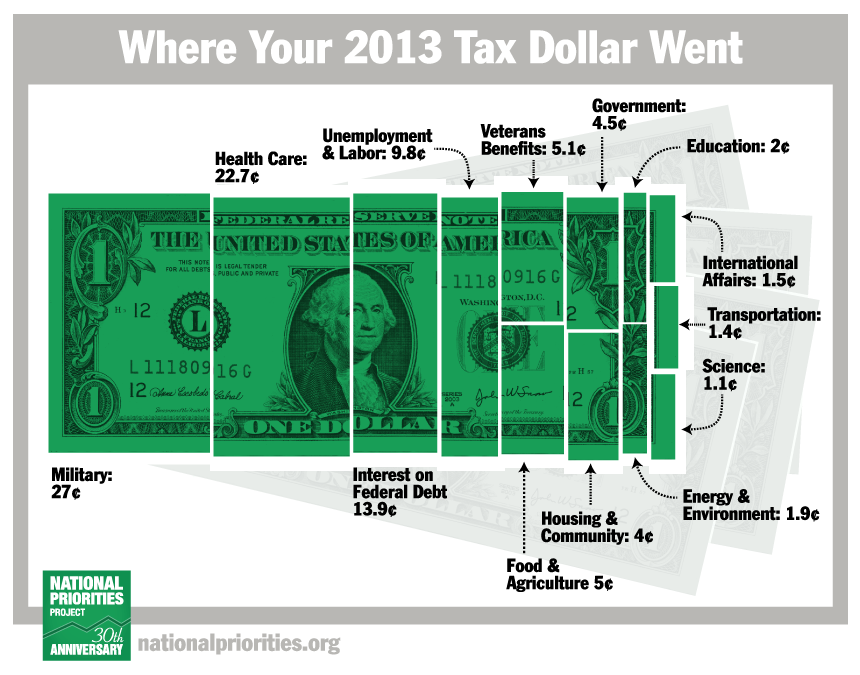
So why are we spending so much on defence and so little on education? In 2013 NationalPriorites.Org showed below how the American Dollar was spent that year :

https://static.nationalpriorities.org/images/charts/2015/taxes-desk.png


So 27% was Military spending while 2% was spent on Education (truth) and 5% on Food and Agriculture and 4% on Housing and Community (plenty). This seems to be out of proportion to need. Health Care (love), one of the biggest spends, still isn't as much as military spending.

Military and Veteran Benefit costs are nearly the same as the costs Health Care, Education, Food and Agriculture and Housing and Community combined. Imagine if the 33% spent on war was instead spent on peace and all its associated truth, love and plenty. The money could be spent on lessening fears whether related to war, or ignorance, or pain or deprivation and help promote the ideals and reality of peace, truth, love and plenty.
It won't happen overnight but we can begin with ourselves and finding the good that is in us all, spread that good and share that good. Look for it in others. Realise that taking a life out of the equation, whether someone else's or our own will not help us to find answers. That we all deserve peace, truth, love and plenty. 

We know the phrase - 'You are your own worst enemy.' Does that mean I am my own Room 101?


References:

McLeod, S. A. (2009). Eyewitness Testimony.
Orwell, G. (1949, 2013) Nineteen Eighty Four, Penguin Classics
Powell, C. (20013) Full Text of Colin Powell's Speech, The Guardian
Tversky, B. & Fisher, G. (1999) The Problem with Eyewitness Testimony 
Tavernise, S. (2013) To Reduce Suicide Rates New Focus Turns to Guns, New York Times, February 13
Radcord, B. (2013) Is Suicide a More Present Danger Than Murder? Psychology, Discovery 

Monday, 15 December 2014

The American Dream, War and The Hobbit

“If more of us valued food and cheer and song above hoarded gold, it would be a merrier world."
(Tolkien, The Hobbit, 1937)

An ungainly, homely creature Bilbo Baggins begins an adventure with the dwarfs in pursuit of the gold of Lonely Mountain in this rural feudal world where we can see the emergence of capitalist pursuits.

What we can learn from the Hobbit (both book and movie):
  • Good people can be corrupted by greed (and this can cause conflict & war).
  • Centralisation of wealth rather than fair distribution causes conflict and war.
  • The West's constant battle to keep its power and reign over the East causes war.
  • Basing judgement on stereotypes or perceived inherited or traditional characteristics of groups blinds people into making uninformed decisions, assumptions and discrimination (and more conflict and war).
  • Seeing the world in terms or different 'races' or groups creates conflict.
  • Patriotism creates an Us and Them agenda...leading to tension, conflict and war.
  • Women have less power in the world and are less present in the ruling elite, and in war!
Is the Tolkien view right-wing or highlighting right wing issues? Is he looking at the Western Democracy of the US and the constitutional monarchy of the UK and finding them lacking in values  or finding them having too much in terms of power and resources?

How do you deal with power? Abolish it with anarchy or give it to a benign dictator or monarch?

As Tolkien told his son:

"My political opinions lean more and more to Anarchy (philosophically understood, meaning abolition of control not whiskered men with bombs)—or to 'unconstitutional' Monarchy." 
(Tolkien, Letters, no. 52, to Christopher Tolkien, 29 November 1943)

And what was Bilbo Baggins? Neither an Anarchist or King but a simple creature with simple tastes who turned out to wield the greatest but least understood power of the story. A simple-living, honourable non-man ended up winning the day. His reward? To live the simple-life he now appreciated.

Why did Tolkien see this through the unlikely character of Bilbo Baggins?

As he said to his son:

"I imagine the fish out of water is the only fish to have an inkling of water."
 (Tolkien, Letters, no. 52, to Christopher Tolkien, 29 November 1943)

Tolkien was a fish out of water for his time and possibly all time, which is why he had such an understanding of it. What you take for granted you don't think about. Bilbo had taken home comforts for granted and didn't realise their value until they were gone.

Perhaps if we all were not so comfortable in our well resourced western waters we might appreciate what we have and what other have not.

Or is the so called 'American Dream' just that, a dream, a lack of consciousness. Is this lack of reasoned thinking why people slavishly chase after material gains like gold? An ever increasing need to have more power, spiralling into the conflict and war between the haves and have-nots? Us and Them?

Every time the treasure of Lonely Mountain, in the west, was sought after, it resulted in conflict, destruction and war, from the tyranny of the dragon raining fire on the town to the wars between Dwarf, Elf and Orc. Gold fever resulted in war.

Is the 'American Dream' war?

Wednesday, 26 November 2014

Doing the Right Thing

'It is far better to endure patiently a smart which nobody feels but yourself, than to commit a hasty action whose evil consequences will extend to all connected with you.'
(Charlotte Bronte in Jane Eyre)

Or to paraphrase the Bible:

Turn the other cheek.

However in the Bible it is providing an alternative tack to take to 'An eye for and eye, and a tooth for a tooth' . So rather than seeking revenge in equal measure to the crime committed, the advice appears to be to provide instead an opportunity of equal measure for the offence to be repeated. This time not out of anger or perhaps in the cold light of day. Is it providing an opportunity for the person to do the right thing? Is it to give them a second change?

Otherwise we are saying that people who suffer domestic violence should just put up with it. Or is it saying that it is as equally ridiculous to use the mantra 'An eye for an eye and an tooth for a tooth' as it is to say that if some one hits you on one cheek that you should give them the other to hit too. Or perhaps it is expanding on the idea that revenge is self-perpetuating and will eventually come back to bite you.

So what is the 'right thing'?
  • I've heard parents tell their kids to hit the bully back.
  • I've heard the tit-for-tat goings on of messy divorces.
  • I've heard the neighbourhood ASBO threatening battles.
  • I've heard the sentences prisoners judges and juries have doled out for crimes.

What is the difference between punishment and revenge? Does it matter? Do either make the world a better place?

I remember a 7 year old saying to me how 'horrible' someone was all the time, that the boy just didn't know how to 'behave'  and everybody said he was 'naughty' so nobody liked him or wanted to play with him and he got into 'trouble' a lot.

We talked about how 'sad' it was that he should make people feel like that but we also discussed how sad it was that he had no friends and how that must feel. But out of the conversation, the most important question was:


'How can someone know how to behave if they are not shown?'


If every time someone behaves in the manner in which they have been brought up or are accustomed to,  they are punished or experience some other form or reinforcement of negative behaviours how will they ever know what appropriate behaviour looks or feels like or have the positive association of reinforcement?

Its trust. How can we expect people to do the right thing if we don't do it ourselves? What will they learn from us?
  • If he hits me and I hit him back. I am saying it is ok to hit. 
  • If he attacks my home and I bomb his back. I'm saying its ok to bomb.
  • If he kills someone and he is given the death penalty. I am saying its ok to kill.
It's not ok to hit, bomb or kill, whatever my justification...whether by tradition, law or military force. We must overcome our baser, immature and reactionary natures. Evolution can't come fast enough. 

Turn the other cheek. If only to give yourself time to think of what to do next, time to develop a plan, a way of dealing with the issues at the root of the problem. To prevent recurrences of the same problem for the same reasons.

Like Gandhi said:

 'An eye for and eye only makes the whole world blind.'

And as Martin Luther King Jnr said:

'Violence as a way of achieving racial justice is both impractical and immoral. It is impractical because it is a descending spiral ending in destruction for all. The old law of an eye for an eye leaves everybody blind. It is immoral because it seeks to humiliate the opponent rather than win his understanding; it seeks to annihilate rather than to convert.'
 (King, 1958, p.213)


52 Quotes on War & Peace  and  some thoughts on Hope
 
King, M, L. (1958) 'Stride Toward Freedom: The Montgomery Story', Harper & Row, New York

Thursday, 20 November 2014

The Story of Us and Them

Us and Them

It was Us and Them. It was always Us and Them. Sometimes there was more of Us and less of Them. Sometimes vice versa. Always verses each other. Always aversion. Always Us and Them. We had to protect ourselves, defend our lands, maintain the borders between our territories. Some were disputed territories - no man's land. That's where the most conflict arose. The intersection. Like the central overlap in the Venn diagram we were taught at school. If the right was yellow and the left was blue the middle would be green. Sun yellow and sky blue would make grass green. It would if we didn't have war. Instead we had bloody red. Not a mixture but a primary colour of its own. No blending of our ways, instead another way - a bloody one.


No one want's to get caught in no-man's land. Not if you can help it. I only remember it happening once. We were out on patrol, saw a movement, investigated and found one of Them there. What’s the saying - the best defence is a good offence? The UN's not always there or on your side, so we went on the offence. We asked Them why they were there. They were lucky we started with interrogation, we could have cut to the chase but we were in a position of strength and flexing our freedom felt more powerful than our strength that day. So we asked why they were there. They didn't answer, instead they asked why we were. And the threat was there. No backing down. A fight to the death was only being postponed until we had strutted our stuff and out witted the other verbally and loudly, before cutting them down to the ground physically. We spat our words out with contempt and defended our right to be there with such ferocity they had no choice but to defend their position and affirm their own right to occupation. We were caught in deadlock. Was negotiation a possibility? We thought not and parried all kinds of heart felt rights from ancestral to legitimate to legal and the odd prosaic reference to other rights like freedom of speech rights and the like. And we proclaimed our heritage and cursed theirs and felt the adrenaline rise. We were warming up for the fight. Ready for battle. Ready for the bloody red. This is how the discussion went:

ME. Why are you here?
YOU. Why are YOU here?
ME. Cos I want to and I can
YOU. Me too.
ME. And my big brother used to come here.
YOU. Well my dad used to come here.
ME. Well I can go anywhere I like
YOU. Well why don't you go back to the swings where you belong.
ME. Why don't You go back to the sand pit?

The contested area was the see-saw on the grass green. But we never even got on it. And we could have together. But we were both too busy stopping the other getting on to realise. So forever, one side of the see-saw pointed silently to the swings and the other to the sand pit. No movement. No sharing of space. No balance. No-mans land.

And sometimes, when the football flew past it to the sand pit, we left it there, even if it was new and even if we had just got it as a present for some celebration. And it never came back. But then again, we had so many tennis and cricket balls from Them we never sent back either. We didn't even use them. They were just trophies in our war.

Then we grew up. We grew to adults and parents and took our children there and forgot our petty wars in the real rights children share: to be loved, cared for and safe. To be able to share the see saw, sand pit and swings. On common ground. The tarmacadam was taken up. The grass green under the see-saw grew all around the sand pit and under the swings, as it had in the beginning. There were no separate lands or people. We were all one. The tarmacadam wars ended but were not forgotten. The grassy knoll, on which the see-saw stood, had buried there, the stories of pain and empty glory. And in the fertile green no blood red grew but instead forget-me-nots of yellow and blue. The centre sun yellow and the petals sky blue with leaves and green stalk rooted to the earth. And the stalks stood firmly like we can. Not for the green of money or of envy but of growth and life and the grass that's just as green on every side.

Grass is green wherever you go
And spilt blood is red.
The same sun shines
From the same sky.
On You and I.
US and Them

Sometimes all we need is time to pass. And sometimes we grow up too fast. And other times we don't grow up at all. And we never get to play with the sand pit, swings and see-saw. We never get to play with any one at all. US or Them.

Tuesday, 18 November 2014

The Long-Long Term

'We can only see a short distance ahead, but we can see plenty there that needs to be done.'
Alan Turing


Alan Turing, played by Benedict Cumberbatch, in the film The Imitation Game tells us so much about ourselves as humans. He shows us how traditions, social norms and laws can ruin lives while giving the  appearance of maintaining a benign status-quo. Although how any level of consistency can be maintained when the world is at war is hard to comprehend. But then that's the excuse. Fear. People are afraid of their ways of life being eroded, their lives being literally blown off the face of the earth.

Change is challenged. Difference is abhorred. New ideas are ridiculed. And if you are someone who is different, with new ideas of how to change the world you are challenged, abhorred and ridiculed. And in the sad case of Alan Turing, finally driven to madness and suicide. 

The horror of war is not in just in the body bags that come back from the front, or the tiny white coffins of the innocent children. It's in the very thought of it. This is an idea that should be challenged, ridiculed and abhorred. How is it not? How can war be seen as a solution for anything?

We are commemorating a hundred years since the outbreak of World War I, as if  war is a thing of the past. Today, according to the Independent,  only 11 countries out of 162 in the world are free from conflict. And its solving nothing. And gettting worse.

We are trying to solve problems which may be beyond us at the moment. They may be beyond our comprehension. Beyond our human evolutionary stage. If we consider violence to be an acceptable solution to violence we have more learning to do.

We look at the short-term or the near-long-term, or the long-term as boundaried by our life spans. As Turing said, 'We can only see a short distance ahead'. Perhaps the problems of the long term need to be addressed over a longer period. Einstein said  that he wasn't smarter than the next person, just that he stuck with the problem longer. We are not sticking with our problems long enough. We want quick fixes and wins. We are afraid of losing. Losing our ways of life. Forgetting our way of life has to change all the time or we don't find roots, grow and flourish.


SEEDS 

When the grim reapers
Cut down the tall poppy
And flowers and plants
Were seen as wayward weeds 
 
And dandelion wishes
Were blowing in the wind
They tried to bury us 
Not knowing we were seeds

As Turing, said there is  plenty that needs to be done for the 'short distance ahead' that we can see. The problem is seeing it and recognising what needs to be done. And not letting it to the poets, visionaries, martyrs and gardeners.   

As  Caecilius Statius knew, even in Roman times, we  plant trees for the benefit of another generation. If only we saw those genereations as an extension of ourselves. Because they are. We are all human. We are the one species on a continuum. The long-long term.

Wednesday, 12 November 2014

Biscuit Politics

As Tony Benn would ask:

How would you feel if you went to the dentist and they said I'm not a dentist myself, haven't learned anything about dentistry, or even read a book on it but my dads a dentist so I'll call myself a dentist? 

Tony Benn, 2011

Tony Benn considered inheriting a title in a similar vein, so renounced his title of Viscount on that basis, which it why it's surprising to read in the Guardian that his son Stephen, is now reclaiming this heriditary peerage.

Speaking at rally in Trafalgar Square 2011
Sadly, he hasn't inherited his father's other title - 'socialist'! No that's something you have to work at and believe in and isn't just a badge you stick on when you fancy it.

Biscuit politics. They are most secure in the shop, labelled, in the packet or box or biscuit tin, with all the other biscuits. On their own, in the hands of the public, it doesn't matter which biscuit you choose, if you hold them in hot water long enough they will break and fall, whether they are chocolate or plain, they all create a splash before finally sinking to the bottom.

Tony Ben wasn't a biscuit, he was the biscuit tin and now he's gone, unfortunately, some of the biscuits have now fallen apart and are just a pile of crumbs. Try dunking that in your tea!

Sunday, 5 October 2014

Acceptance kills hope

Would we bother doing anything if we just accepted our lot? What would be the point? Nothing to be gained. We'd probably be happier. With realistic to no expectations. No need to dream. No need for fiction. No need for an imagination. Or the future. Just the here and now. No coulds or woulds, or the impossible, or improbable or odd or strange.

Listening to a friend's questioning of why people don't accept their lot I became aware of why I didn't. Mainly because otherwise I might not leave the sofa. With everything that was either hard or scary, if I didn't think there was some chance that things would get better why would I bother? I said to him, something along the lines of  'acceptance kills hope'. He agreed whoelheartedly and delightedly recounted a scene in the play Separate Tables by Terence Rattigan, where Major Pollack ask Miss Cooper about her lost love. 'Any hope?' he asks. She replies, cheerfully, 'No, none at all.' He asks why she's so cheerful about it and she tells him that there no point in being any other way. She says, 'I've settled for the situation you see, and its surprising how cheerful one can be when one give up hope.'

Could I be happier if I stopped hoping? My friend reminded me of the proverb 'What can't be cured must be endured.' But I amended it in my head to the less pithy: 'What can't be cured for now must be endured until....'  Or otherwise we would continue to live with polio, small pox and cancer. At one time none of these could be cured and if simply endured would not be eradicated as they have been and are being.

Marching in today's demonstration in the rain, in flip flops, with my rainbow PEACE flag over one shoulder and umbrella over the other, through Parliament Square to Downing Street, there was plenty of time to think. There was a background wash and sound-track of anti-war banners, Peace banners, placards saying 'Welfare not Warfare', chanting:

One, two, three, four - we don't want another war
Five, six, seven, eight - stop the killing, stop the hate

A French news camera appears in my face and I am asked by the cameraman, why I'm marching. I point to my flag. For Peace, I tell him. Peace as a process that doesn't just happen over night or can be brought about by bombs. He asks me what I thought of the death of Alan Henning. I said that it was shocking, as every death is shocking, and that nothing is solved by bombs. Peace is a process. A long one. 

And we need hope.

So I don't accept that we fight fire with fire so we're all end up burnt. And it can't be an eye for an eye until we're all blind. We just can't teach peace through war.

So.

I hope for better. I march for better. I try to do better.

And hope.

'Everything that is done in the world is done by hope.'
Martin Luther


52 Quotes on War and Peace

Luther, M. (1848) Table Talk or Familiar Discourse of Martin Luther (translated by W. Hazlitt), David Bogue, London

Sunday, 28 September 2014

52 Quotes on War and Peace


Quotes on war and peace for every week of the year. I chose the 52 I could most identify with from the hundreds on Anti-War.com.

  1. Force is all-conquering, but its victories are short-lived. Abraham Lincoln
  2. In war, truth is the first casualty. Aeschylus
  3. One is left with the horrible feeling now that war settles nothing; that to win a war is as disastrous as to lose one. Agatha Christie
  4. It is my conviction that killing under the cloak of war is nothing but an act of murder. Albert Einstein
  5. Nothing will end war unless the people themselves refuse to go to war. Albert Einstein
  6. Peace cannot be kept by force. It can only be achieved by understanding. Albert Einstein
  7. War is never a solution; it is an aggravation. Benjamin Disraeli
  8. When will mankind be convinced and agree to settle their difficulties by arbitration?Benjamin Franklin
  9. There never was a good war or a bad peace. Benjamin Franklin
  10. War does not determine who is right, only who is left. Bertrand Russell
  11. All forms of violence, especially war, are totally unacceptable as means to settle disputes between and among nations, groups and persons. Dalai Lama
  12. We must pursue peaceful end through peaceful means. Dr. Martin Luther King Jr.
  13. All wars eventually act as boomerangs and the victor suffers as much as the vanquished. Eleanor Roosevelt
  14. It isn't enough to talk about peace. One must believe it. And it isn't enough to believe in it. One must work at it. Eleanor Roosevelt
  15. No weapon has ever settled a moral problem. It can impose a solution but it cannot guarantee it to be a just one. Ernest Hemingway
  16. Every war when it comes, or before it comes, is represented not as a war but as an act of self-defense against a homicidal maniac. George Orwell
  17. War is a way of shattering to pieces...materials which might otherwise be used to make the masses too comfortable and...too intelligent. George Orwell
  18. War against a foreign country only happens when the moneyed classes think they are going to profit from it. George Orwell
  19. Political language. . . is designed to make lies sound truthful and murder respectable. George Orwell
  20. Observe good faith and justice toward all nations. Cultivate peace and harmony with all. George Washington
  21. Every government has as much of a duty to avoid war as a ship's captain has to avoid a shipwreck. Guy de Maupassant
  22. Be not dumb, obedient slaves in an army of destruction! Be heroes in an army of construction! Helen Keller
  23. Even philosophers will praise war as ennobling mankind, forgetting the Greek who said: ‘War is bad in that it begets more evil than it kills.' Immanuel Kant
  24. Violence is the last refuge of the incompetent. Issac Asimov
  25. War will exist until that distant day when the conscientious objector enjoys the same reputation and prestige that the warrior does today. John F. Kennedy
  26. Peace is a daily, a weekly, a monthly process, gradually changing opinions, slowly eroding old barriers, quietly building new structures. John F. Kennedy
  27. The great enemy of the truth is very often not the lie: deliberate, continued, and dishonest; but the myth: persistent, persuasive, and unrealistic. John F. Kennedy
  28. For what can war, but endless war, still breed? John Milton
  29. Victory attained by violence is tantamount to a defeat, for it is momentary. Mahatma Gandhi
  30. What difference does it make to the dead, the orphans, and the homeless, whether the mad destruction is wrought under the name of totalitarianism or the holy name of liberty and democracy? Mahatma Gandhi
  31. An eye for an eye makes us all blind. Mahatma Gandhi
  32. Liberty and democracy become unholy when their hands are dyed red with innocent blood. Mahatma Gandhi
  33. There is no way to peace. Peace is the way. Mahatma Gandhi
  34. I object to violence because when it appears to do good, the good is only temporary; the evil it does is permanent. Mahatma Gandhi
  35. We all have to be concerned about terrorism, but you will never end terrorism by terrorizing others. Martin Luther King III
  36. The chain reaction of evil--wars producing more wars -- must be broken, or we shall be plunged into the dark abyss of annihilation. Martin Luther King, Jr.
  37. Wars are poor chisels for carving out peaceful tomorrows. Martin Luther King, J
  38. Man must evolve for all human conflict a method which rejects revenge, aggression, and retaliation. Martin Luther King, Jr.
  39. Peace is not merely a distant goal that we seek, but a means by which we arrive at that goal. Martin Luther King, Jr.
  40. Nothing good ever comes of violence. Martin Luther King, Jr.
  41. If you want to make peace with your enemy, you have to work with your enemy. Then he becomes your partner. Nelson Mandela
  42. Everybody's worried about stopping terrorism. Well, there's a really easy way: stop participating in it. Noam Chomsky
  43. Man has no right to kill his brother. It is no excuse that he does so in uniform: he only adds the infamy of servitude to the crime of murder. Percy Bysshe Shelley
  44. Violence and arms can never resolve the problems of men. Pope John Paul II
  45. Humanity should question itself, once more, about the absurd and always unfair phenomenon of war...Pope John Paul II
  46. Peace cannot be achieved through violence, it can only be attained through understanding. Ralph Waldo Emerson
  47. Civilization began the first time an angry person cast a word instead of a rock. Sigmund Freud
  48. If you live long enough, you'll see that every victory turns into a defeat. Simone de Beauvoir
  49. All wars are fought for money. Socrates
  50. Peace is not the absence of war; it is a virtue; a state of mind; a disposition for benevolence; confidence; and justice. Spinoza
  51. War is an instrument entirely inefficient toward redressing wrong; and multiplies, instead of indemnifying losses. Thomas Jefferson
  52. Peace demands the most heroic labour and the most difficult sacrifice. It demands greater heroism than war. Thomas Merton

History Repeating

I marched in 2003/4 with the students of our school and I will be protesting again this coming Saturday the 4th of October.

Why ? Check out why Stop the War Coalition think Iraq and Syria should not be bombed.

As Franklin D. Roosevelt said 'Repetition does not transform a lie into a truth.'

~